
Validating Your Product: Analysing Competition
Many people think that competition is bad. However, this is far from the truth. Competition is good.
Why?
Because if there is competition shows you there’s a market and a demand for your product. Plus, you can analyse your competition to discover how to make the product even better. It means you don’t have to start from new.
Therefore, you don’t need to fear competition. It means that someone else has tested the market for you.
Find out what your competitors are doing and how it compares with what you plan to create.
You can also check out your competition’s social media to see how engaged their customers are with their posts and products. Also, read any negative feedback about products and see if you can find a way to improve.
By carrying out a competitor analysis, you can give your customers not only what they want but a better version.
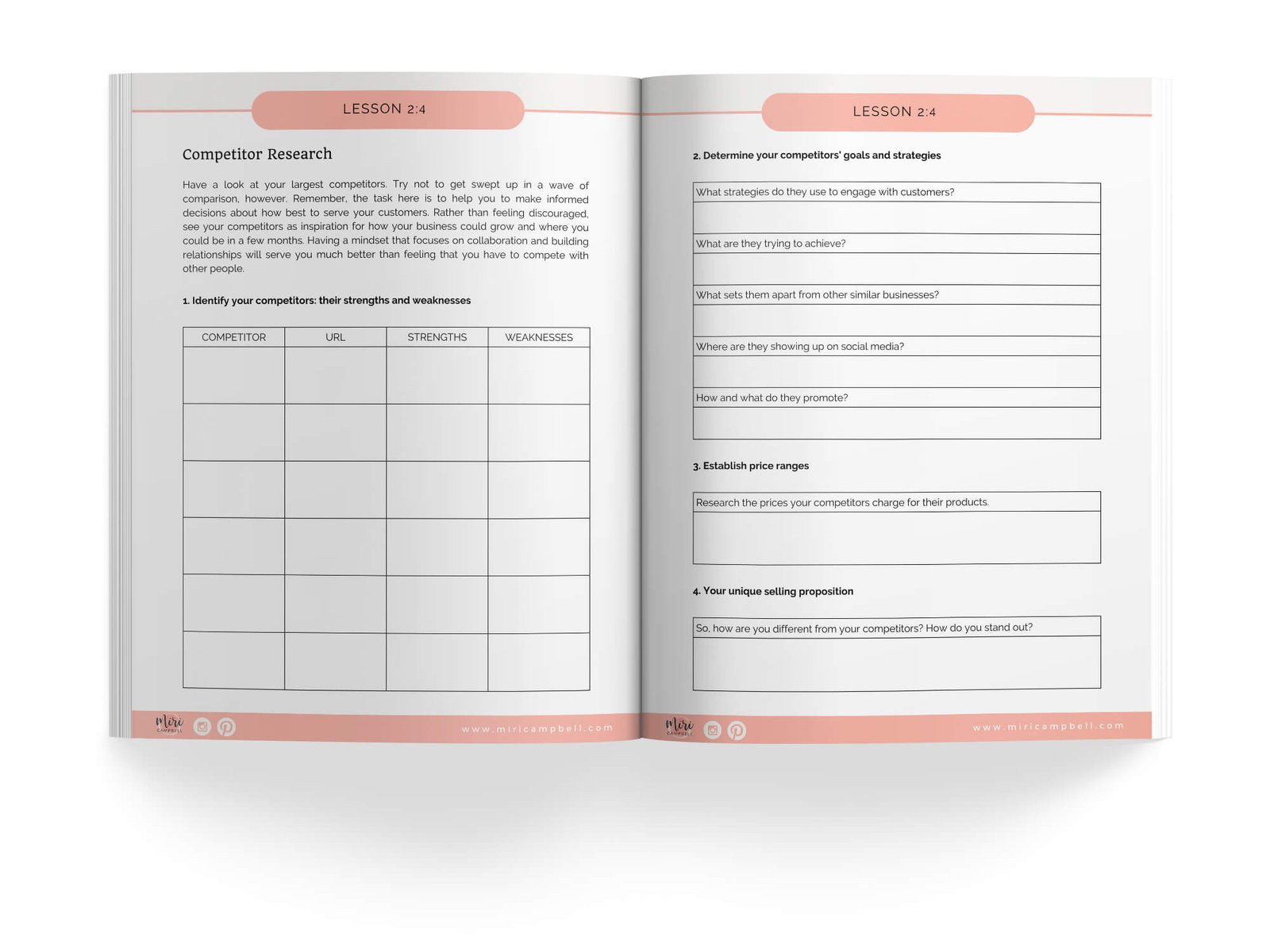
Turn to page 14 and 15 of your workbook to record the information you find for the following tasks:
Conduct a Competitor Analysis
So, to start your competitor analysis, head over to Etsy and type into the search bar a broad term for the product you want to make.
Now, scroll through the results and choose products to investigate further.
Make a note of shops that show up again and again, or shops that have high numbers of sales. Choose a selection of these shops to explore further.
Competitors’ Strengths and Weaknesses
Fill in the Competitor Analysis table in your workbook to evaluate the strengths and weaknesses of each of the competitors you find.
From this research you can learn about the kind of products customers are spending money on and what businesses are doing to attract these customers.
Competitors’ Goals and Strategies
Next, consider your competitors’ goals and strategies. Think about the following questions and use the workbook to record your answers.
- What strategies do they use to engage with customers?
- What are they trying to achieve?
- What sets them apart from other similar businesses?
- Where are they showing up on social media?
- How and what do they promote?
(Please note – researching competitors’ products and shops is purely for inspiration and doesn’t mean stealing or copying their ideas)
What’s Missing and What Gap Can You Fill?
As you conduct your research, you’ll start to notice products that are missing and finding gaps in the market that you could fill.
You’ll also discover ways that you can be different from your competitors and stand out. Record these ideas in your workbook
If you’ve identified a product that is in demand, perhaps you can differentiate your product.
Think about a new way to create it or a different way to use it.
For example you could think about
- Access – are there different ways your customer might use or access your product (for example, making a digital planner rather than printable)
- Audience – change the audience – take something you’ve seen and design it for a completely different audience. For example use the idea of a travel planner but make it specifically for parents with small children.
- Size – alter the size of a product. Tiny planners made to fit handbags and purses.
- Quality – perhaps you could create a more expensive, luxurious version of the product or alternatively a more budget-friendly version.
Workbook Exercise
Module 2: Lesson 4
Complete the tables with information about your competitor research.