
Your Target Audience
A Guide to Finding Your Perfect Etsy Customer
Defining your Etsy target audience is one of the most important tasks when setting up your Etsy shop.
Consequently, the better you understand your customer the more closely you can focus your planner products and marketing to address the needs of your audience and the more powerful you’ll be.
So, I’m going to share here the exact steps I use to identify who my perfect customer is.
Etsy Target Audience: Understand Your Customers and Clients
Understanding who it is that will be buying your digital products, is crucial for a successful Etsy shop.
In other words, you are aiming to create an experience where your customer says, “That’s just what I was looking for.”
Also, you want them to wonder how you read their mind and how you knew this is what they needed.
So, for this to happen you need to understand your customer completely. That is to say, you need to know their fears, their hopes and what they are thinking and needing.
This way you can create a brand and streamline your marketing that addresses exactly what your customers need and want.
Although there is a huge audience available to you, you want to imagine one person you focus on serving.
Just one person.
Because if you have a larger group you’re trying to market to, then you risk diluting your focus.
In trying to attract everyone, you’ll end up attracting no one.
Narrowing down to one person means you can be focused in understanding what this person wants and needs.
Identify an Ideal Customer
Identify an ideal customer that makes up your Etsy target audience
In this lesson we will go through a simple process that identifies a clear ideal customer that your business serves.
Overall, you’ll define a specific person that you want to reach with your planner products.
You do need to get really specific here in order to see results.
It’s really important that your ideal customer should be developed from audience research, not just guesswork.
How Do You Find This Ideal Customer?
We are going to use the Target Customer worksheet on page 10 of the workbook to help us narrow down who your ideal customer is.
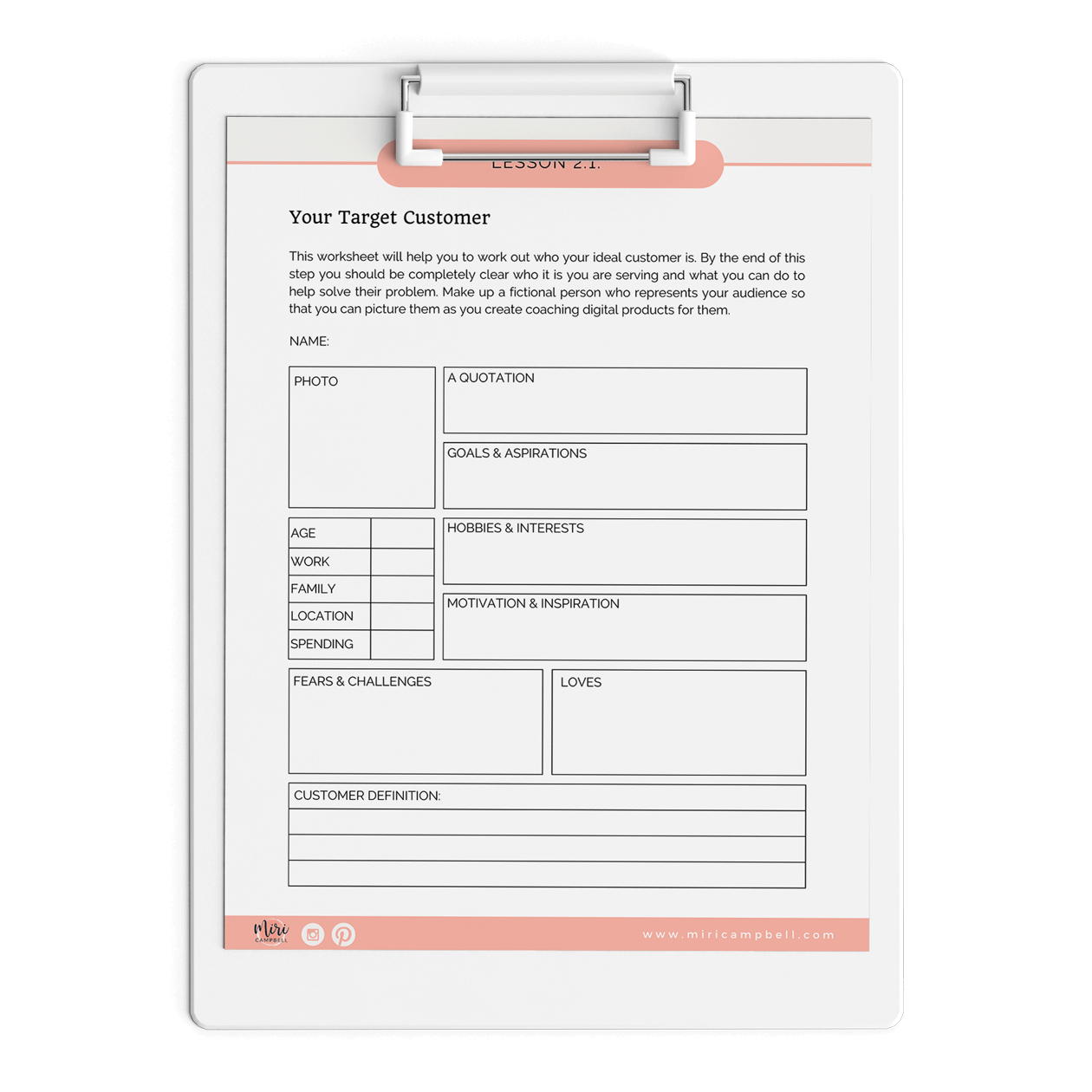
So, let’s work through the worksheet now.
1. Make up an imaginary ideal customer
The first thing you need to do is make up your imaginary ideal customer.
Certainly, it might help if you think of an ideal existing customer. What makes them a perfect fit for your business? Do they have traits that you value? Imagine a person that you know you can serve because you know what they need and want.
Also to help with this, you might like to identify who is already buying your products. As soon as you understand the characteristics of your existing customers, you can target more of the same audience.
So, now your task is to define one person and from that work out how you will connect with them.
Don’t be too serious about this. Create an imaginary customer who values what you have to offer and make up a name for them. (I had fun with this name generator trying to find an imaginary name.)
2. Add a photo
Next, look for a photo in magazines or online to illustrate what your imaginary ideal customer looks like. Add their photo to your worksheet.
3. Add some details
Then add the following information to your worksheet:
- Age – no need to be specific, just know the decade or generation
- Work – what job do they do?
- Family – who is in their family?
- Location and time zone – where are your customers in the world and what time are they active? Where do they hang out online?
- Spending power – how much money do they have to spend? What influences their buying decisions?
- Inspiration – who inspires them?
4. Choose a quotation that represents this person
5. Goals and aspirations
Following this, consider any goals or aspirations your ideal customer has. What does she most want to achieve? Add these to your worksheet.
6. Hobbies and interests
Then think about what hobbies or interests your customer has. What do they do to relax? What books do they read? What podcasts do they listen to? What blogs do they follow? By building up a picture of how your customer spends their free time gives you a great insight into how you can connect with them.
7. Motivation and inspiration
After this decide what motivates your ideal customer. What is important in her life? What values does she have? What does she believe in?
8. Fears and challenges
Now imagine the fears and challenges your ideal customer faces. What stops her from getting what she wants? What are her biggest pain points and frustrations? What worries stop her from sleeping? Write these down.
9. Favourites list
Then make a list of favourites. What is her favourite book / food / film / travel destination / song etc? List all of your ideas on the worksheet.
10. Short bio
Lastly, write a short bio for your customer highlighting factors that make this person an ideal customer.
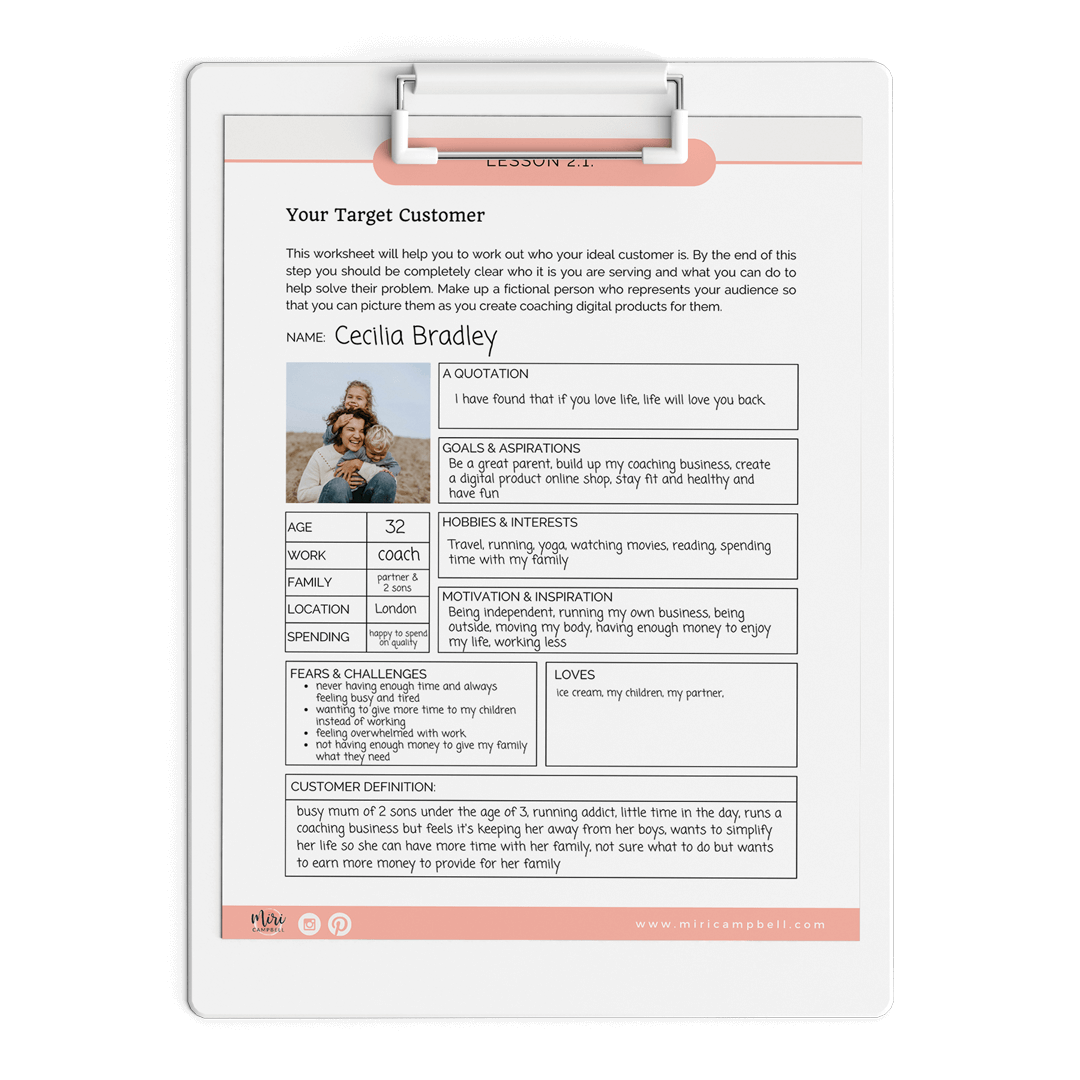
My Completed Target Customer Worksheet:
To help you with filling out the Target Customer worksheet, here’s the one I did to identify my ideal customer for my shop:
Contact Your Ideal Customer
Next, it would be great if you could Skype call some potential customers who fit your ideal customer character and interview them directly. See if you can find anyone who will agree to this and I promise you, the value you’ll get from it will be enormous.
See page 12 of theworkbook which will help you put together a questionnaire for your potential customers.
Ask questions that draw out what your ideal customer wants, what they’ve tried in the past, what they’re planning to do in the future, and what their pain points are. Talk about your product with this small Etsy target audience and get their feedback on what they think about it.
Aim to carry out 8 – 10 interviews in order to focus in on what your ideal customer needs.
Additionally, you could survey some of your social media followers or alternatively, you can investigate online. What are people talking about? Are they asking certain questions? Do they have any challenges?
Great places to find this information are:
You know her so well…
At the end of this exercise, once you’ve identified your target customer, you’ll know what she needs; how she thinks; how much she is able to spend; her values as well as any objections she has.
And knowing all of this you can now create products specifically for your Etsy target customer confident that they’re going to add value to her life.
You can write all of your emails to her. In fact, you’ll know her so well you’ll be talking to her in your sleep!
So that’s it. Now, have some fun completing the exercises in the workbook and using them to help you define your ideal customer.
Let me know in the comments below who your ideal customer is and how you found doing this activity. I can’t wait to hear how you get on.
Workbook Exercise
Module 2: Lesson 1
Complete your Target Customer worksheet and your Target Customer Survey worksheet.